

Introduction: Why a Professional 3D Printing Service?
After publishing my ESP32 Robot Car Chassis on Printables and detailing it in my book, I often get asked where the best place is to have the parts printed. The “Robot Car Chassis” consists of many individual parts, and their 3D printing quality is crucial for the stability of the finished robot.
That’s why I was happy about the cooperation request from PCBWay, who approached me on their own initiative after I had already linked their service here on my blog in August. My goal: to test the quality of their 3D printing service and show my community a reliable source. Here is my detailed experience report, from ordering and delivery to quality inspection.
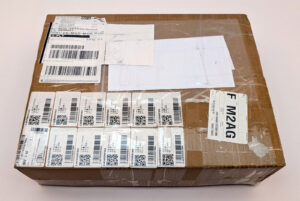
PCBWay Package
1. The Order: Simple Process and the Sponsorship
The Ordering Process: The first impression was very positive. Instead of printing the chassis myself, I simply uploaded the 12 most essential STL files of my robot car (which I provide on ESP32 Robot Car Chassis – Modular & Open Source Base) to PCBWay.
- User-friendliness: The configurator is intuitive. You select material (e.g., PLA or PETG), color, quantity, and the parameters.
- Variety of Parts: My print job consisted of 12 individual orders, as I couldn’t upload more files in one job. Managing the 12 files was surprisingly easy thanks to PCBWay’s well-structured shop page.
The Cooperation Model: PCBWay offered me a Sponsorship of 150 USD for the printing and shipping costs. These were credited to me after we agreed that I would publish my impressions here.
- Cost Transparency: The total cost amounted to $174.30 USD for 3D printing and shipping only. Thanks to the credit, I only had to pay the remaining balance of $24.30 USD myself.
- Shipping Costs: The shipping costs were 66.98 USD and are already included in the $174.30 USD total.
- The High Cost (Honesty): At this point, I want to be honest with you: I didn’t think that the 3D printing alone would be so expensive at 105.99 USD, especially since I expected further costs for customs and handling by DHL at that time.
- Confirmation: The process was fast: received credit, paid the remaining balance, and the job went into production.
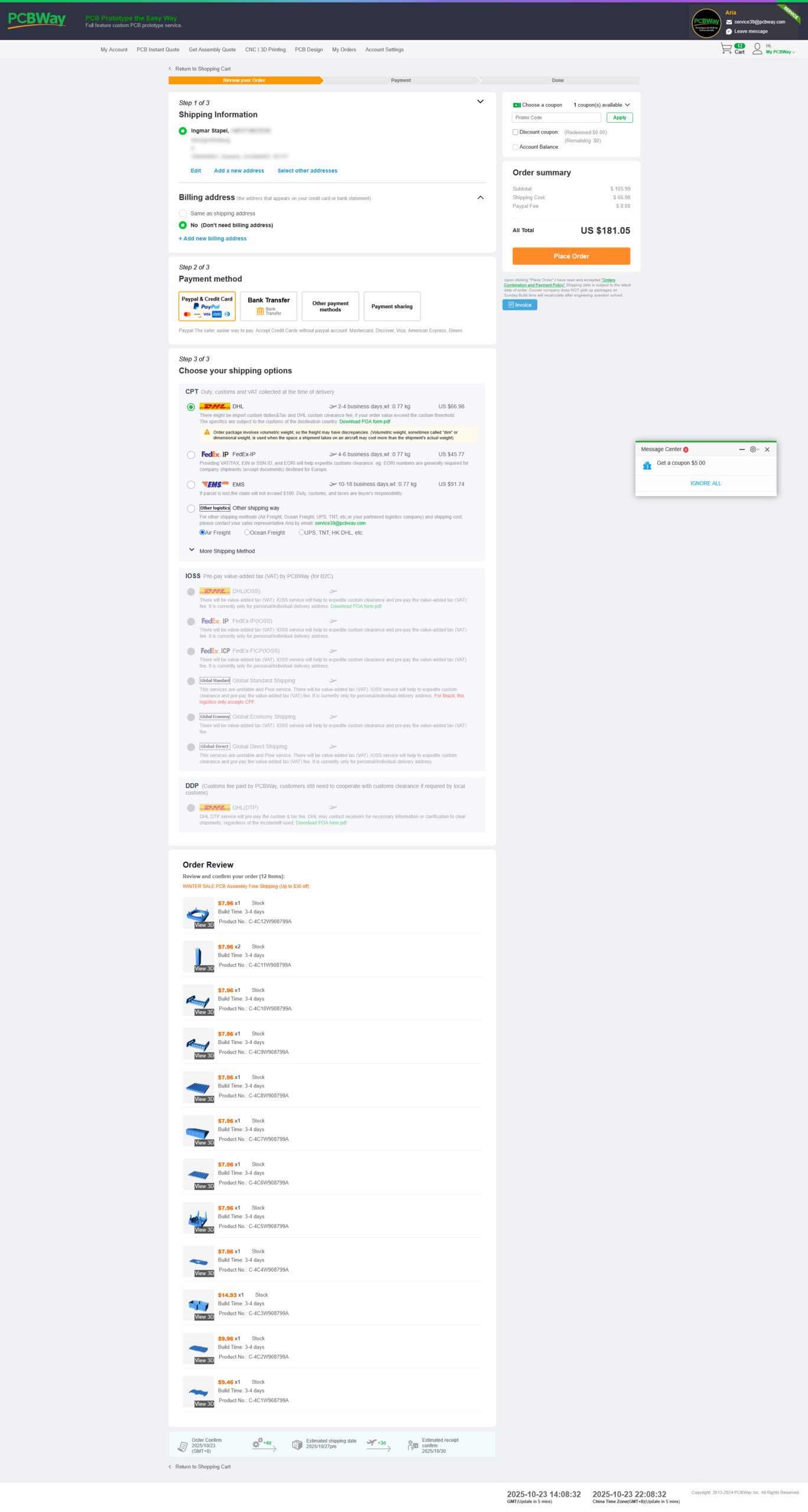
PCBWay Order
2. Manufacturing and Shipping
The time from payment to shipping was astonishingly fast.
- Manufacturing Time: After payment, the order was manufactured within 2 days.
- Shipping: I chose DHL as the shipping service provider and received clear tracking. The pure shipping time from China to Germany was only 3 days.
3. The “Reality Check”: Customs and Fees Due
An important point to always consider when ordering outside the EU is customs clearance.
- Customs Clearance: DHL wrote me a message stating that a bill of materials, a description of the package contents, and a statement of the parts’ value were needed. I simply uploaded the invoice, which also showed the credit, and briefly explained the purpose of the 3D printed parts.
- Fees Due: As agreed, I covered the import VAT (19% in Germany) and any customs duties or service fees of the shipping provider myself, which amounted to an additional 44.87 Euros – and were based on the entire amount of 174.30 USD. Important for my readers: These costs always apply upon import. You should plan for at least the 19% extra.
- Customs Conclusion: The process was simple and transparent, and I could easily pay the necessary fees via PayPal.
- How expensive was it in the end? Converted to Euros, I paid approx. 194.87 Euros for the printed chassis.
4. Unboxing and Quality Inspection
Finally, the package! After the customs fees were paid, the package was released by customs in Leipzig and delivered to me within another day.
- Packaging: The package was very robust, and the 3D printed parts were extensively padded. The individual parts were separately packed to prevent damage.
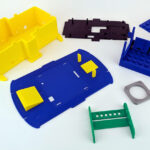
- First Impression: The parts in Yellow and Blue and the material PLA look fantastic and are very cleanly printed. No visible defects or coarse imperfections.
Here’s a look inside the open package. It’s great to see how neatly and safely everything was packed. That really amazed me, and I was very pleased about it.
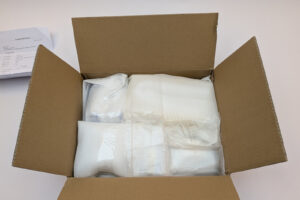
PCBWay Package open
Detailed Quality Assessment
This is the most critical part. How good was the print in terms of the fit of my modular chassis?
- Surface Quality: The layer height is great, and everything is very cleanly printed. The surfaces are smooth, and no post-processing was required.
- Dimensional Accuracy (Tolerances): The modular parts of the chassis must fit exactly into each other, as I designed them. I have to say, all parts fit together very precisely, and I foresee no problems assembling the ESP32 robot car chassis. Example: The designated holes for the motor mounting fit perfectly, and the screw points were precisely printed.
- Stability: The selected material PLA feels very stable and durable. The load capacity is more than sufficient for the robot car.
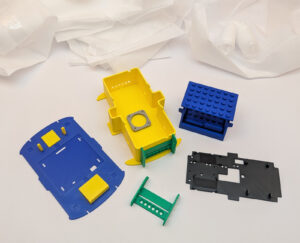
PCBWay Package open components
PCBWay Homepage:
- Here you will directly find the PCBWay 3D printig page: PCBWay 3D-Druck
- Here you go for the PCBWay christmas sale: PCBWay christmas 2025 sale
5. The Shared-Projects Program – The Solution for My Community
PCBWay also introduced me to the Shared-Projects Program. This is the perfect solution for those of you who don’t want to upload 12 individual files!
- The Idea: I will upload my complete ESP32 Robot Car Project to the PCBWay platform as a “Shared Project”.
- Your Advantage: You can order the entire chassis set with just one click and only need to select the color. This saves time and avoids configuration errors.
- Link to the PCBWay Shared Project: Coming soon! I still need to clarify with PCBWay how I can bundle all parts into a single project.
- My Advantage: As the author, I receive a small commission for every order through this program. A genuine win-win situation, because honestly, not much is earned from the sale of the book, and the costs for such a project are by far not covered by it!
Conclusion and Recommendation
The collaboration with PCBWay 3D Printing was a complete success. The handling was professional, the shipping was fast, and the print quality for a complex, functional robotics chassis was absolutely convincing.
- Clear Recommendation for everyone who needs high-quality, durable parts quickly and doesn’t own a 3D printer or wants to save time.
- Cost vs. Benefit: Although the high cost of 194.87 Euros surprised me, the acquisition of a 3D printer is also not to be underestimated if you only want to print an ESP32 Robot Car Chassis once.
- Next Steps: Look out for the second post, in which I present the finished robot car with the PCBWay parts, as well as the link to the Shared-Projects Program!
Links:
- https://www.pcbway.com/rapid-prototyping/3d-printing/
- [Link zum PCBWay Shared Project (Sobald vorhanden)]
- My ESP32 Robot Car Model on Printables: ESP32 Robot Car Chassis – Modular & Open Source Base




Recent Comments